Pages

Showing posts with label wood frog. Show all posts

Saturday, May 10, 2014

Finally spring in Duluth!

Spring has finally arrived in Duluth!

Vernal pools (small, temporary wetlands) are almost ice free and wood frogs and spring peepers are starting to breed. Get out and hear the chorus of the early spring breeding frogs - it only lasts a few weeks.

Video of spring peeper calling 
(another spring peeper and chorus of wood frogs in the background)

Spring peeper - with characteristic X on back
Wood frogs in amplexus
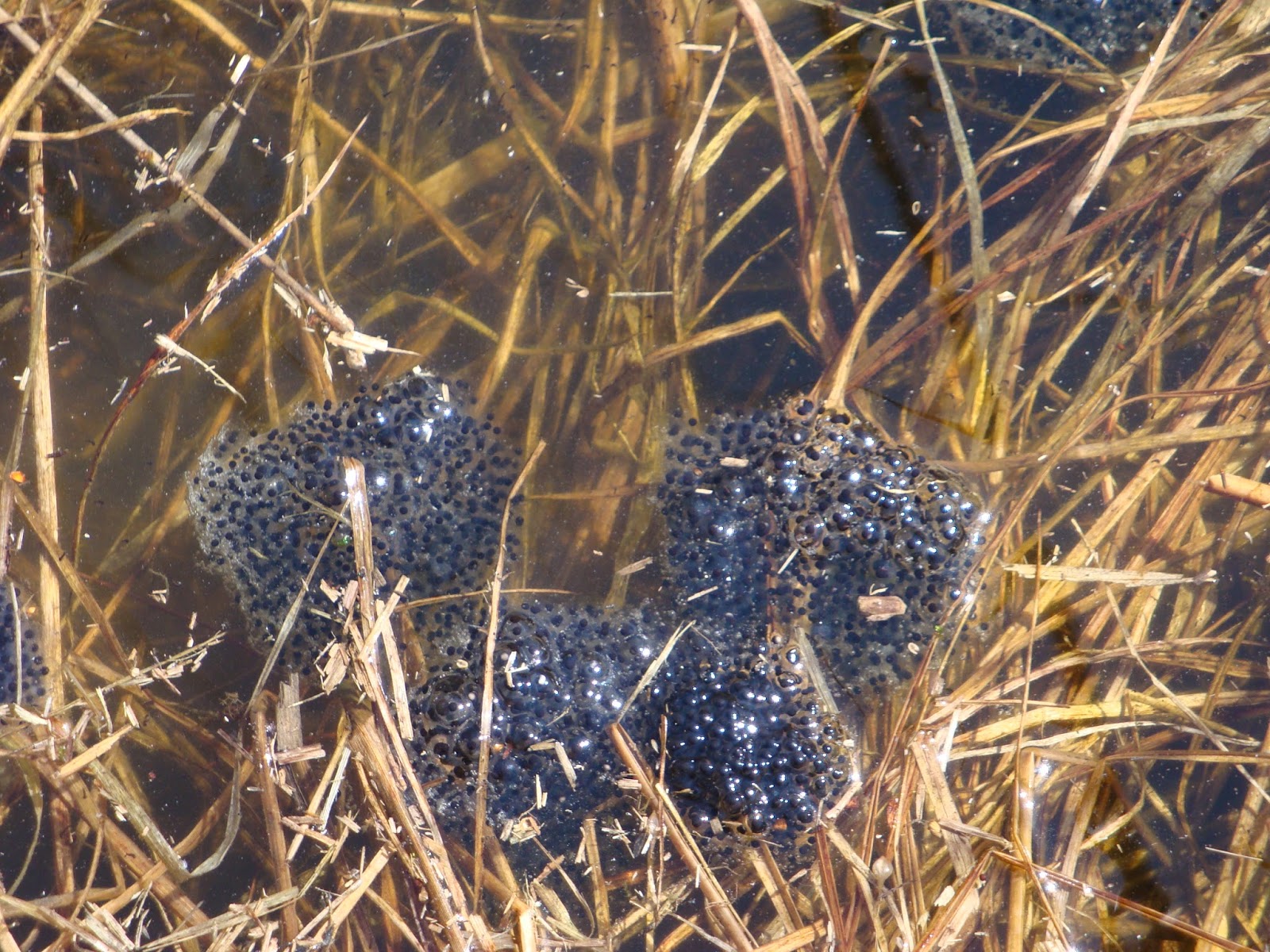
Newly laid wood frog eggs
 

Wednesday, April 11, 2012

How are frogs impacted by the early spring?

The early spring could benefit or harm the frogs. We have several frog species that start calling (and breeding) as soon as the ice-melts in wetlands and small ponds.

The earliest breeder of these is the wood frog (Rana sylvatica), which sounds like quark-quark. This species emerges from hibernation as soon as the small wetlands they breed in have open water. Wood frogs can benefit from the early spring by breeding earlier, which gives their tadpoles longer time to grow over spring and summer. Bigger tadpoles turn into bigger froglets, which increases their likelihood of survival through the fall and following winter.
Adult wood frog
HOWEVER, early springs are often associated with low snow pack, which means that these small, usually temporary, ponds start the season with much lower water levels than in a typical spring. As these ponds are generally fed by snowmelt and precipitation (no, or little, connection to groundwater), the water levels at wood frog breeding time are directly tied to snowmelt, and maintaining adequate water levels for tadpoles to develop depends on spring and early summer rains. If the ponds dry up in June (even for just a few days), before the tadpoles metamorphose into frogs, the entire generation of frogs from the pond is lost.

Another impact of the early spring is the possibility of extended calling for wood frogs (who usually just call for a few days to a week) which could greatly exhaust the males as they wait for females to arrive in the ponds to lay eggs. Male frogs arrive in ponds first and beginning calling individually or in groups. Females arrive later, select a mate (based on factors we don't fully understand) and lay eggs. In an early spring, male wood frogs can start calling WEEKS before the eggs are laid - especially if the weather shifts between warm and cold several times a week. Frog calling is very energetically demanding activity, and male wood frogs complete breeding before foraging for food on the forest floor. If the warm spring weather starts and stops (as it has this year), the male wood frogs could get really worn out and deplete their energy reserves while calling on and off for multiple weeks while they wait for the weather to be consistently warm enough for the females to arrive and be ready to lay eggs.

(as posted on Ask NRRI)

Friday, April 6, 2012

Wood frog eggs - April 6, 2012

Reports of frog calls have been coming in for 2 weeks. First reports were on Friday March 23, 2012 from Hartley Park - the earliest date since I've been keeping track. Most likely these were all wood frogs.

Last week, frogs started and stopped calling a few times. Now I can say it is spring because the wood frogs have started laying eggs! I found my first wood frog eggs this afternoon, amidst a full chorus of calling wood frogs.
 
Example of wood frog eggs (freshly laid)

Lots of egg masses in one pond, but only a few in another - I expect egg laying will continue over the next few days.

Wood frogs are explosive breeders, meaning that they lay all their eggs during the same short stretch of days (usually in one central location per pond).


I will continue to follow the development of eggs and tadpoles in these and other ponds through the spring and summer.

Thursday, April 5, 2012

Early Spring in Duluth!

Reports of wood frogs calling are coming in weeks earlier than last year.

All you need to do to see the early spring is look out the window and remember what it looked like last year.

Wood frog breeding habitat - April 2011

In case you need more than your own eyes:

Scenes from an Early Spring - MPR report from last week

Saturday, August 13, 2011

Sign of a Healthy Lawn


I never thought about our city lawn as good frog habitat, but it must be a good location for hunting after some rain (and when the lawn is left a little longer).  This week there were two HUGE adult wood frogs hopping around in the lawn - the bigger one got away before I got to see it, but the smaller one was almost as wide as it was long. 


Seeing this frog, presumably gorging on the abundant insect life in our sunny lawn, reminded me why we don't use any chemicals on the lawn and try to limit chemical use on our property.  

Amphibians are very sensitive to chemicals released in the environment. 

Unfortunately, lawn care practices could be detrimental to the survival of urban frogs, toads, and salamanders due to the fact that homeowners use many times more pesticides per acre than applied in agricultural areas.

The most important things that you can do to protect amphibians in your yard are:
1) Choose non-chemical weed controls
2) Minimize fertilizer use
3) Minimize pesticide use
4) Provide natural habitat for foraging and corridors

More details can be found in the U.S. Fish and Wildlife Service's Homeowner's Guide to Protecting Frogs: Lawn and Garden Care or on the USFWS website.

Saturday, July 23, 2011

Wood Froglets

Less than three months after the eggs were laid, young wood frogs are emerging from ponds and wetlands around Duluth.  Wood frog metamorphosis occurs fairly quickly and can be easily observed in pond edges.  

Over the last two weeks wood frogs in Hartley Park transformed from 2 inch long tadpoles into froglets about 3/4" long. 

The rainstorms that have rolled through Duluth this week likely encouraged wood frogs to emerge from the wetlands. There are many froglets hopping along the wet forest floor - watch for them on the trails and your lawn. 
Wood frog at Gosner stage 40/41. Hindlimbs are fully developed, forelimbs are about to emerge from under skin.

Wood frog at Gosner stage 42. Forelimb just emerged, full tail remains.
 
Wood frog at Gosner stage 43. Tail somewhat reduced.

Wood frog at Gosner stage 44. Tail greatly reduced.

Wood frog at Gosner stage 45. Only small tail stub remains.
Another wood frog at Gosner stage 45.

Amphibian growth and development is dependent on many factors, including temperature, availability of food, water depth, and photoperiod (the amount of daylight).  Many amphibian species can accelerate or delay larval (tadpole) development and metamorphosis based on quality of their aquatic habitat. Although most wood frogs in a pond transform into froglets at approximately the same time (calling synchronous metamorphosis), multiple stages can usually be found during a visit.
 
Wood frogs resting on a floating board.  Top at Gosner stage 44 or 45, bottom at Gosner stage 42.

*The Gosner staging system was developed for Northern Leopard Frog (Rana pipiens) to identify key points in developmental progress from embryo through metamorphosis, also used for other Ranid species such as the wood frog (Rana sylvatica). citation: Gosner KL. 1960. A simplified table for staging anuran embryos and larvae with notes on identification. Herpetologica 16:183-90.

Sunday, May 8, 2011

Developing Wood Frog Eggs

Finally, the wood frog eggs are starting to develop into tadpole shaped embryos.  I expect these eggs to hatch next week.

Fresh wood frog eggs are very easy to spot......
wood frog eggs masses - freshly laid
....but are harder to find as they develop. Egg masses lose their distinct shape and symbiotic algae turns them greenish, making the eggs blend in with the general pond vegetation and organic matter.
wood frog egg masses - newly hatched
close up of wood frog egg mass - freshly laid

Due to the transparent gelatin-like coating, embryo development can be followed from fertilization through hatch. The embryo (black ball at center of egg in left photo) begins to elongate and grow into tadpoles. The eggs hatch before the tadpoles are able to swim, so they remain in or on the egg masses for several days (see below).
close up of newly hatched wood frog tadpoles


Wood frog eggs hatch 4 to 28 days after being laid.  Embryonic development is temperature dependent, so timing of hatch varies with weather conditions. 

Sunday, April 17, 2011

Still waiting for spring

I have not received any new reports of frogs calling in the Duluth area since Thursday, when the temperatures dropped and then a snowstorm blew in.  The birds have continued to sing, so I don't doubt that spring is truly here.  However, this weather has probably slowed the frogs down.  I don't expect any more frog activity until it warms up again, probably Thursday based on the current weather predictions.

Wood frogs (Rana sylvatica) are the first to start calling around Duluth.  The wood frog call is usually described as 'quark-quark-quark' or duck-like. Wood frogs are easily recognizable by a dark mask and white lip line.  In overall color they range from light to dark brown and sometimes are pink or reddish. 
wood frog
Within a few days, wood frogs are joined by Western Chorus Frogs (Pseudacris triseriata) and Spring Peepers (Psedacris crucifer). Both of these frogs are very small, reaching only 1 inch or 1.5 inches as adults, but make very LOUD calls. Chorus frogs sound like running your thumb over a comb and spring peepers make a really loud 'peep' over and over. Chorus frogs range in color from tan to brown to green and can be recognized by the strips on their back. Spring peepers are generally light tan with a slightly darker brown X on their back. 
chorus frog

spring peeper


To see when frogs begin to call across North America see the map at Journey North Spring 2011 - First Frogs

Next week I'll give some tips on identifying wood frog eggs (along with photos).

Wednesday, April 13, 2011

Waiting for Wood Frog Calls.....

Reports have come in of wood frogs (Rana sylvatica) calling south of Duluth (around Solon Springs, WI) AND north of Duluth.  So now I am waiting for them to start calling here!


One wood frog sounds like 'quark-quark-quark' and a full chorus of wood frogs make a huge racket.

Listen to this chorus of wood frogs heard about this time two years ago:


Wood frogs will call during the day as well as evening and night.  Listen for them on your next walk through the woods or local parks- pretty much anywhere that there are small to medium wetlands.

Monday, April 11, 2011

Spring is Finally Here!

That was the talk of the neighborhood this morning as we left for work in 50 degree temperatures.  Looks like tomorrow will be spring again, but the following few days may take us back to late winter.

It has only been 4 days since I visited the frozen wetlands, but I will head out again tomorrow to see if they have opened up yet.  If the vernal pools are open, we can expect the wood frogs to be calling and laying eggs in about a week!

In case you were wondering what these amazing northern frogs might be up to right now - they are probably in the process of thawing out.  Yes, wood frogs are the famous frozen frogs!  Most amphibians find more suitable habitat for winter hibernation, such as a sandy hole below frostline or the muddy bottom of a larger lake, but wood frogs spend the winter frozen in the leaf litter.

This NOVA segment is a great intro to frozen frogs


You can learn more at: Frozen Frog: Expert Q & A (Jon Costanzo)

Thursday, April 7, 2011

Is it spring yet?

Spring comes slow to northern Minnesota - this year it seems exceptionally slow, perhaps due to the super early spring of 2010.  Although the robins and cardinals are singing in my yard, we will be waiting a few more weeks before the frogs start to call.

I visited some ponds located within city limits today - still frozen and snow covered (see below).

Quite a difference from this time last year, when the ponds were open and the wood frogs had already laid their eggs! On April 7, 2010 this same location looked something like this:

While we wait for the ponds and lakes to open up, all we can do is practice our amphibian ID skills.  The first frog to call and breed in this region is the wood frog (Rana sylvatica). I recommend the Online ID Guide from Northern Prairie Wildlife Research Center for great pictures and maps, and the Amphibians of Reptiles of Minnesota for detailed descriptions and calls.